Camadas Lineares e Funções de Ativação
Camadas Lineares
Funções de Ativação
Após as operações de cada camada linear, costuma-se uma função de ativação não linear para permitir que a rede aprenda representações complexas. As redes neurais iniciais faziam muito uso das funções de ativação Sigmóide e Tangente Hiperbólica. Porém, nas redes neurais profundas, a função de ativação mais utilizada é a ReLU (Rectified Linear Unit), que é simples, eficiente e reduz o problema do gradiente desaparecendo. Uma variação desta última é a Leaky ReLU, que mantém um pequeno valor negativo para entradas menores que zero, evitando o problema dos neurônios “mortos” que nunca ativam. Mais recentemente, a GeLU (Gaussian Error Linear Unit) tem sido usada em arquiteturas avançadas, pois suaviza a transição entre valores negativos e positivos com base em uma função probabilística, oferecendo melhor desempenho em alguns cenários, especialmente em modelos de larga escala.
ReLU
A função de ativação ReLU (Naim & Hinton, 2010), popularizada com a AlexNet (Krizhevsky et al, 2012), é uma das mais utilizadas em redes neurais modernas devido à sua simplicidade e eficácia. Sua fórmula é , o que significa que ela transforma valores negativos em zero, enquanto mantém valores positivos inalterados. Isso introduz não-linearidade na rede, permitindo que ela aprenda padrões complexos. Comparada a funções de ativação anteriores, como sigmoid e tanh, a ReLU tem a vantagem de ser computacionalmente mais eficiente e de mitigar o problema do desvanecimento do gradiente, uma vez que seus gradientes são constantes para entradas positivas. No entanto, ReLU também pode sofrer com o problema de “neurônios mortos” quando muitas unidades se tornam zero, o que pode ser tratado com variantes como Leaky ReLU e GeLU (gaussian error linear unit).
import numpy as np

import matplotlib.pyplot as plt
x = np.linspace(-5, 5, 101)
y = np.array([max(i, 0) for i in x])
plt.plot(x, y)
plt.xlabel('x')
plt.ylabel('ReLU(x)')
plt.grid()
plt.show()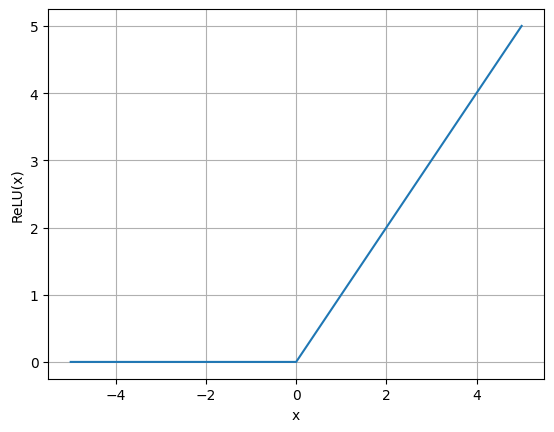
Variantes (Leaky ReLU e GeLU)
Para diminuir problemas de neurônios mortos, variantes como Leaky ReLU e GeLU possuem valores diferentes de zero quando X é negativo. Leaky Relu, utilizando um certo valor , possui o formato , enquanto GeLU pesa a entrada pelo quanto ela é provável de ser positiva sob uma distribuição normal padrão.
from scipy.special import erfx = np.linspace(-5, 5, 101)
lrelu = np.array([max(i, 0.05*i) for i in x])
gelu = 0.5 * x * (1 + erf(x / np.sqrt(2)))
plt.plot(x, lrelu)
plt.plot(x, gelu)
plt.xlabel('x')
plt.ylabel('f(x)')
plt.grid()
plt.legend(['Leaky ReLU', 'GeLU'])
plt.show()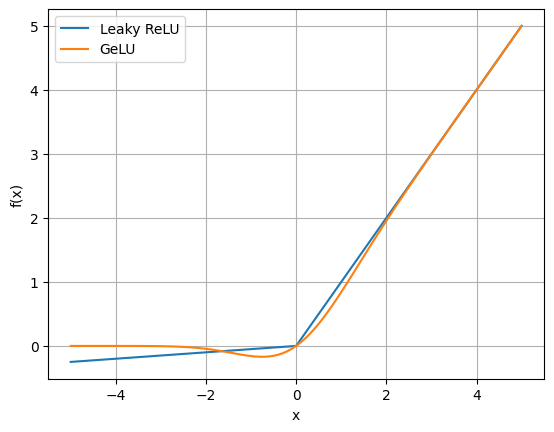
Exemplo com redes neurais profundas
import torch
import torch.nn as nn
class MLP(nn.Module):
def __init__(self, input_size, hidden_size, n_layers=2, non_linearity=True):
super().__init__()
self.non_linearity = non_linearity
self.layers = nn.ModuleList()
in_dim = input_size
# Hidden layers
for _ in range(n_layers - 1):
self.layers.append(nn.Linear(in_dim, hidden_size))
in_dim = hidden_size
# Output layer
self.output_layer = nn.Linear(in_dim, 1)
self.activation_fn = nn.LeakyReLU() if non_linearity else nn.Identity()
# 🔧 Zero all biases
for layer in self.layers:
if hasattr(layer, 'bias') and layer.bias is not None:
nn.init.zeros_(layer.bias)
if hasattr(self.output_layer, 'bias') and self.output_layer.bias is not None:
nn.init.zeros_(self.output_layer.bias)
def forward(self, x):
activations = []
for layer in self.layers:
x = layer(x)
if self.non_linearity:
x = self.activation_fn(x)
activations.append(x)
out = self.output_layer(x)
return out, activationsimport numpy as np
from sklearn.datasets import make_circles
from torch.utils.data import DataLoader, TensorDatasetdevice = 'cuda' if torch.cuda.is_available() else 'cpu'X, y = make_circles(n_samples=200, noise=0.1, factor=0.4, random_state=42)
X = torch.tensor(X, dtype=torch.float32)
y = torch.tensor(y, dtype=torch.float32).unsqueeze(1)
dataset = TensorDataset(X, y)
dataloader = DataLoader(dataset, batch_size=32, shuffle=True)
model = MLP(input_size=X.shape[1], hidden_size=2, n_layers=5, non_linearity=True).to(device)
criterion = torch.nn.BCEWithLogitsLoss()
optimizer = torch.optim.Adam(model.parameters(), lr=1e-3)import matplotlib.pyplot as pltfrom tqdm import tqdmnum_epochs = 10_000
# num_epochs = 1000
loss_logs = []
for epoch in tqdm(range(num_epochs)):
# Start epoch loss
running_loss = 0.0
for b, (X_batch, y_batch) in enumerate(dataloader):
# Forward pass
outputs, _ = model(X_batch.to(device))
loss = criterion(outputs, y_batch.to(device))
# Backward pass and optimization
optimizer.zero_grad()
loss.backward()
optimizer.step()
# Update running loss
running_loss += loss.item()
# Update epoch loss
loss_logs.append(running_loss/b)
# tqdm.write(f"Epoch [{epoch+1}/{num_epochs}], Loss: {running_loss/b:.4f}")
# Plot loss
plt.plot(loss_logs)
plt.ylabel('Loss')
plt.xlabel('Epoch')
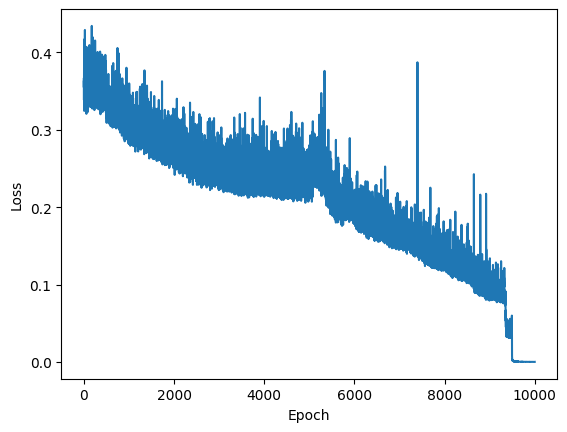
plt.show()100%|██████████| 10000/10000 [02:34<00:00, 64.72it/s]
@torch.no_grad()
def plot_decision_boundary(model, X, y, show_activations=False, resolution=0.01, cmap='cividis'):
    """
    Plot the decision boundary for a 2D torch model.

    Args:
        model: torch.nn.Module that outputs predictions or (pred, activations)
        X: torch.Tensor of shape (N, 2)
        y: torch.Tensor of shape (N,) or (N,1)
        show_activations: if True, also plot intermediate activations as subplots
        resolution: grid resolution for the mesh
        cmap: color map for contour plot
    """
    device = next(model.parameters()).device
    X, y = X.to(device), y.to(device)

    # Build grid
    x_min, x_max = X[:, 0].min().item(), X[:, 0].max().item()
    y_min, y_max = X[:, 1].min().item(), X[:, 1].max().item()
    xx, yy = np.meshgrid(np.arange(x_min, x_max, resolution),
                         np.arange(y_min, y_max, resolution))
    grid = torch.tensor(np.c_[xx.ravel(), yy.ravel()], dtype=torch.float32, device=device)

    # Model prediction (handle models returning activations)
    output = model(grid)
    if isinstance(output, tuple):  # (y_pred, activations)
        Z, activations = output
    else:
        Z, activations = output, None

    instances_output = model(X)
    if isinstance(instances_output, tuple):  # (y_pred, activations)
        Z_instances, activations_instances = instances_output
    else:
        Z_intances, activations_instances = instances_output, None

    # Convert logits to binary predictions
    if Z.ndim > 1 and Z.shape[1] == 1:
        Z = Z.squeeze(1)
    Z = torch.sigmoid(Z) if Z.dtype.is_floating_point else Z
    Z = (Z > 0.5).float()
    Z = Z.cpu().numpy().reshape(xx.shape)

    # Main plot
    fig = plt.figure(figsize=(8, 8))
    contour = plt.contourf(xx, yy, Z, alpha=0.5, cmap=cmap, antialiased=True)
    plt.scatter(X[y == 0, 0].cpu(), X[y == 0, 1].cpu(), s=10, label="Class 0")
    plt.scatter(X[y == 1, 0].cpu(), X[y == 1, 1].cpu(), s=10, label="Class 1")
    plt.xlim(x_min, x_max)
    plt.ylim(y_min, y_max)
    plt.xlabel('x₀')
    plt.ylabel('x₁')
    plt.legend()

    # Optionally show activations
    for l, (activation, activation_instances) in enumerate(zip(activations, activations_instances)):
        n_neurons = activation.shape[1]
        fig, axes = plt.subplots(1, n_neurons + 1, figsize=(6 * n_neurons, 4))
        if n_neurons == 1:
            axes = [axes]
        a = activation.detach().cpu().numpy()
        ai = activation_instances.detach()
        for i in range(n_neurons):
            Z = a[:, i].reshape(xx.shape)  # only first neuron
            axes[i].contourf(xx, yy, Z, alpha=0.5, cmap=cmap, antialiased=True)
            axes[i].scatter(X[y == 0, 0].cpu(), X[y == 0, 1].cpu(), s=10, label="Class 0")
            axes[i].scatter(X[y == 1, 0].cpu(), X[y == 1, 1].cpu(), s=10, label="Class 1")
            axes[i].set_title(f"Layer {l+1} activations for neuron {i+1}")
            axes[i].set_xlabel('x₀')
            axes[i].set_ylabel('x₁')
        axes[i+1].scatter(ai[y == 0, 0].cpu(), ai[y == 0, 1].cpu(), s=10, label="Class 0")
        axes[i+1].scatter(ai[y == 1, 0].cpu(), ai[y == 1, 1].cpu(), s=10, label="Class 1")
        axes[i+1].set_title(f"Layer {l+1} output")
        axes[i+1].set_xlabel('Neuron 1')
        axes[i+1].set_ylabel('Neuron 2')
        plt.tight_layout()

    plt.show()

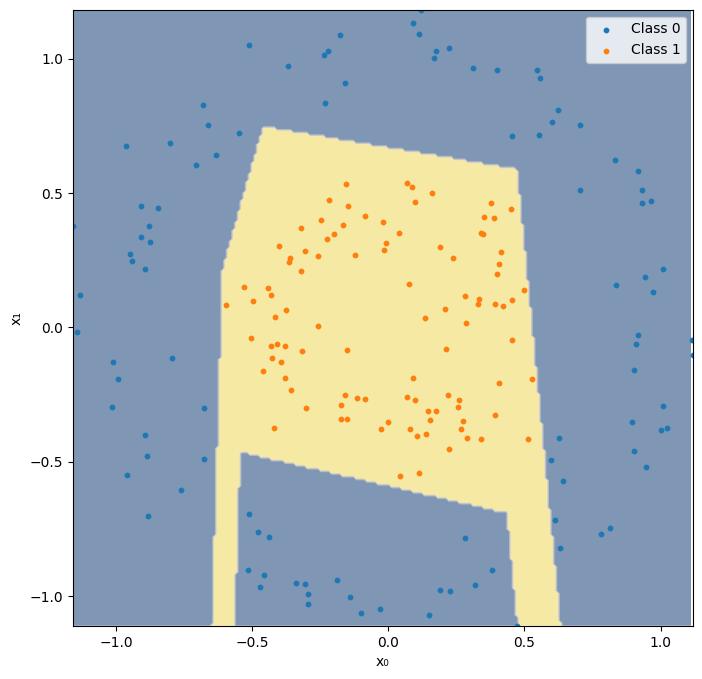
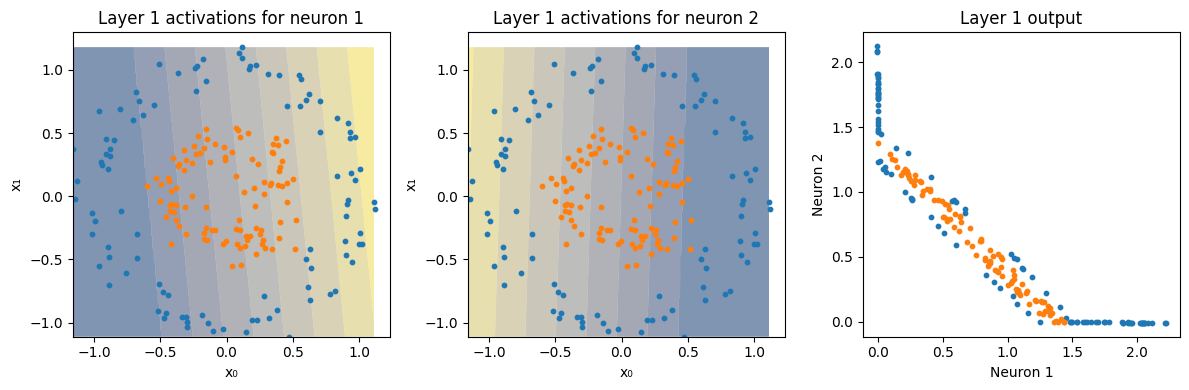
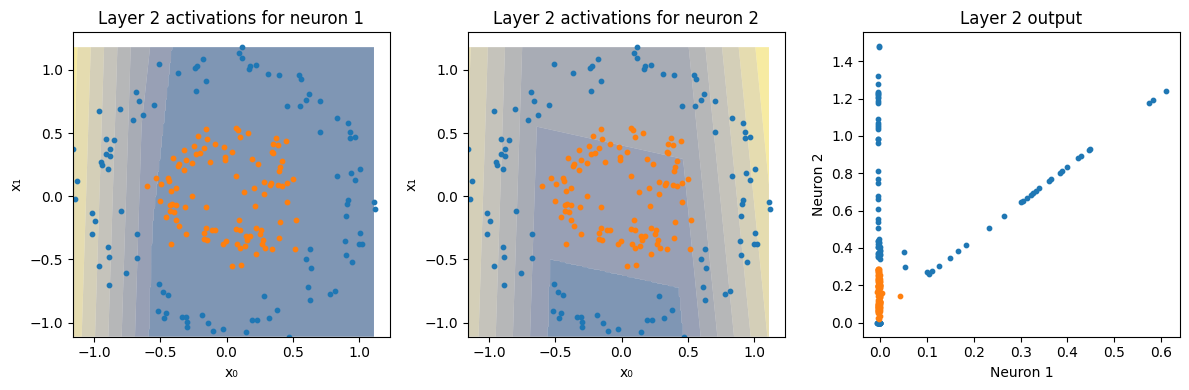
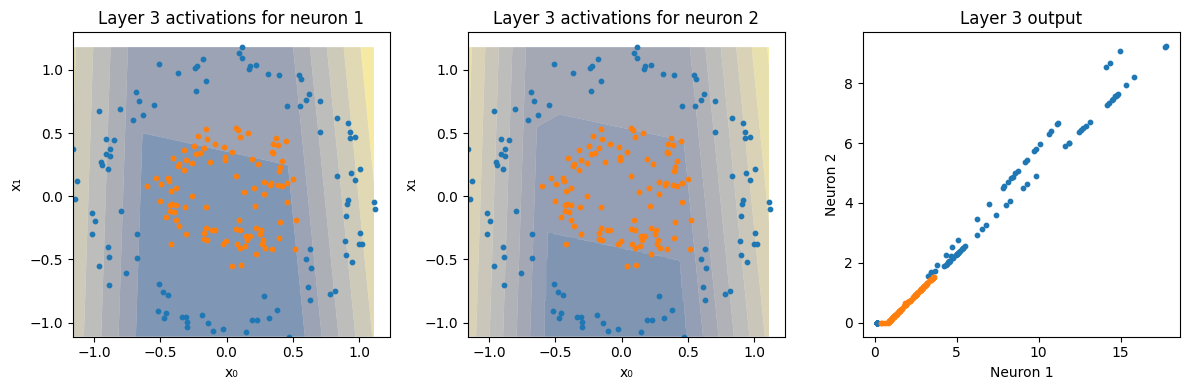
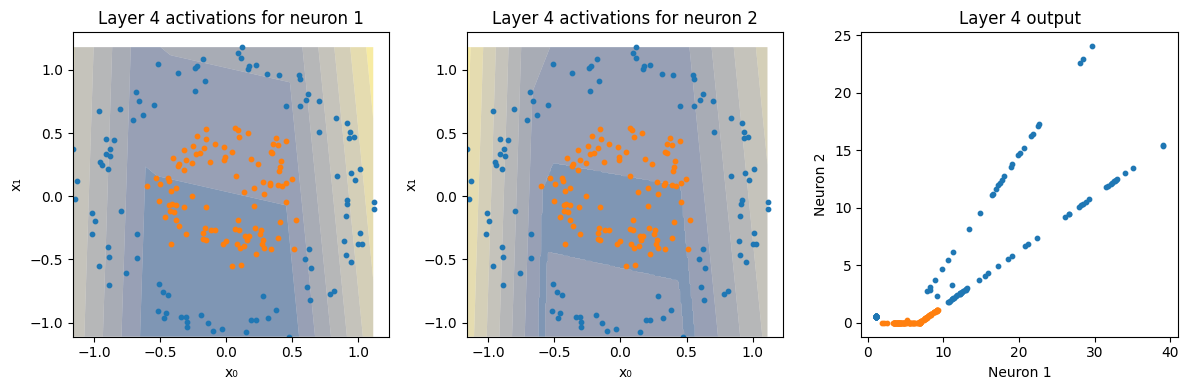
plot_decision_boundary(model, X, y[:,0], show_activations=True)